
Three languages that were blocking each other
An online certification platform with remote proctoring. English, Italian and Turkish versions shared a domain with no hreflang and split queries between themselves, in a niche search treats almost as carefully as health and finance. We separated the three locales by hreflang and URL structure, rewrote certification pages around the questions asked before payment, and put most of the budget into links – this niche does not move otherwise.
- Industry
- EdTech, online certification
- Market
- English, Italian, Turkish
- Period
- 13 months
- Metric
- Organic visits a month, at the end of the period
- Starting point
- not disclosed
- Result
- 40,800
- Main work
- Separating three locales that were competing with each other, hreflang, credential architecture
Figures are taken from the client's own analytics for the period stated.
The acceleration starts in month seven – once the links had accumulated and the certification pages were already rewritten. Neither of the two produces this curve on its own.
Numbers from the client's analytics
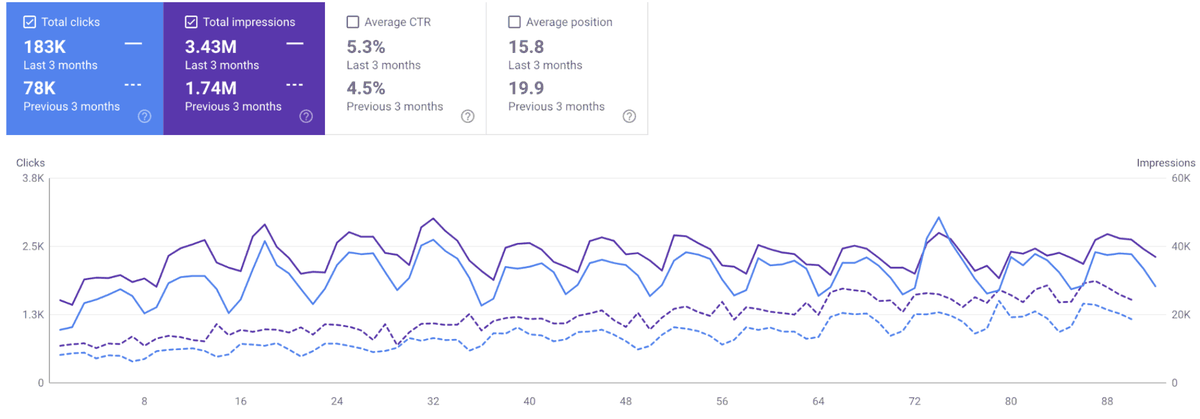
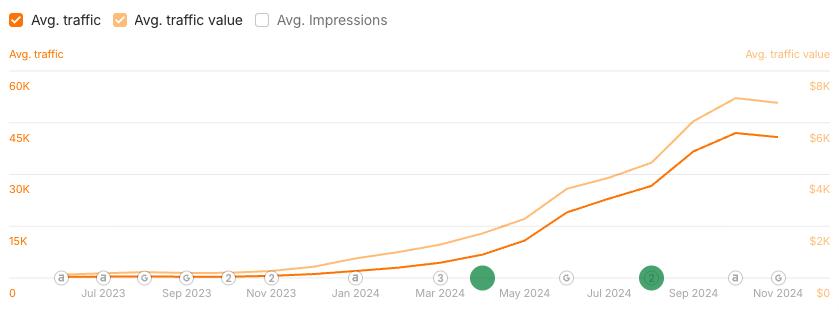
Screenshots are exports from the client's tools for the period stated, unretouched.
Three problems, each blocking growth
Three language versions were cannibalising each other
The English, Italian and Turkish versions shared one domain with no hreflang, overlapping canonicals and colliding URLs. Google picked a version per query on its own and almost always picked the wrong one: Italians got the English page, Turkish users got the Italian one.
The certification pages answered nothing
An exam page carried a name, a price and a button. Not a word on who recognises the certificate, how proctoring works, how long it takes, what happens if you fail, what the document itself looks like. Those are precisely the questions somebody asks before paying.
The link profile could not carry the niche
Online certification sits close to health and finance in how carefully search treats the source. Two hundred referring domains against fifteen hundred for competitors meant no amount of on-page work would move it alone.
Four stages over thirteen months
Separating the locales
Split the three locales across the URL structure, set hreflang with self-references on every version, fixed canonicals and closed the cross-language duplicates. In parallel, the usual technical work: speed, rendering, indexation of the exam catalogue.
Traffic barely moves at 1,500 visits. But Italian and Turkish pages start showing in their own regions for the first time.
Answering the questions
Rewrote the certification pages to one structure: who recognises the document, how proctoring works, how long the exam takes, what happens if you fail, a sample certificate, issue times. Built the architecture along two axes – by certification type and by profession.
3,200 visits by month five. Conversion on exam pages rose before traffic did – people stopped leaving to find answers on forums.
The main bet
This is where most of the budget went. Outreach to education portals, professional associations, career blogs and university resource pages. Plus digital PR around research on how the labour market values certifications.
9,500 visits by month nine. Competitive queries the site could never reach start to move.
Locales, not translations
Rebuilt the keyword research for Italy and Turkey rather than translating the English set. Certification names, the phrasing of requirements and the professional vocabulary are all local. Outreach ran through native speakers. The client's conversion on both markets came out above English.
40,800 visits by month thirteen. Italian and Turkish account for a third of traffic and noticeably more than a third of revenue.
Want the same breakdown for your project?
Our Head of Inbound Sales will look at your site and niche and tell you what you can realistically expect. Including when the answer is “not much”.
Let's see what's holding your product back
We'll go through your site and niche and show you where the losses are. Free, and the document is yours.