
Twenty months of almost nothing, then 3.5× in a quarter
A proxy provider selling into the US and EU, in a niche where the link profile matters more than the content: competitors held three to four thousand referring domains, the client had two hundred. Closing that gap was the project's main bet – 1,400 referring domains in two years – alongside country-and-type clusters instead of one template with a variable swapped in, and a blog rewritten around buyer jobs rather than definitions.
- Industry
- Infrastructure, proxy provider
- Market
- US and EU
- Period
- 24 months
- Metric
- Organic visits a month
- Starting point
- 2,400
- Result
- 22,000
- Growth
- +817%
- Main work
- Country and type clusters, a job-driven blog, 1,400 referring domains
Figures are taken from the client's own analytics for the period stated.
The flat stretch through month twenty-one is not idle time, it is link equity accumulating. In infrastructure niches this is the normal curve: nothing for a long time, then everything at once.
Numbers from the client's analytics
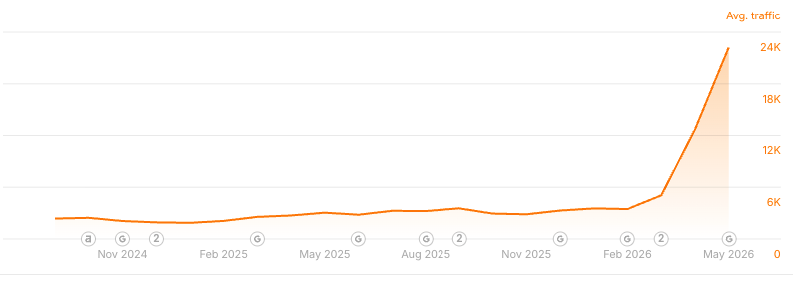
Screenshots are exports from the client's tools for the period stated, unretouched.
Three reasons the project was stuck
The geo pages existed, they just were not indexed
Hundreds of “proxies in <country>” pages were generated from one template: the same title with a variable swapped in, the same description, not a single internal link. Google saw an array of duplicates and kept under a third of them. The content existed on paper and nowhere else.
The niche runs on links, and there were none
In infrastructure niches the link profile decides more than the content does: competitors held three to four thousand referring domains, the client had two hundred. No amount of internal linking or copy closes that gap.
The blog was written for the wrong reader
Thirty articles explaining what a proxy is – the stage at which nobody buys anything. The people who pay are looking for a solution to a specific job: pull data from a marketplace, verify ad delivery in another country, test geo-targeting.
Four stages over two years
Fixing the template
Technical audit and an indexation review. We rebuilt the geo-page template so it assembles from real pool data: size, ASN types, median latency, supported protocols. Mapped demand across 180 countries and 40 cities and split proxy types into separate clusters.
Traffic sits at 2,400 visits. Only the indexed share moves – from 31% to 88%.
The main body of work
Rolled out the geo clusters: residential, datacenter and mobile per country, plus city variants for the larger markets. The job was to avoid breeding duplicates: every page carries its own pool figures, its own latency measurements and a block on local specifics – regulation, typical use cases.
4,500 visits by month nine. Geo pages pick up the long tail but stall on competitive terms – they run into the link gap.
The slow part
Rewrote the blog around jobs rather than definitions: guides on marketplace data collection, ad verification, geo-targeting tests, and comparisons of proxy types per scenario. Link building started in parallel – the project's main bet: outreach to automation blogs, tool directories and technical publications.
5,300 visits. The gain is barely visible, and that is expected: link equity accumulates before it converts.
All at once
Link building reached a steady rate – 60 to 80 new referring domains a month, 1,400 across the project. AI search work started in parallel in month sixteen and is described separately below.
Still around 6,000 visits through month twenty-one. Then 22,000 within three months. Links do not grow traffic linearly: they accumulate, then fire at once.
A separate workstream
We ran 200 queries from the niche through ChatGPT, Perplexity and AI Overviews – the client was named nowhere. Key pages were rewritten to be citable: comparison tables of which proxy type suits which job, concrete numbers instead of vague promises, direct answers in the opening paragraph. Added schema and llms.txt, and started work on independent reviews and tool directories.
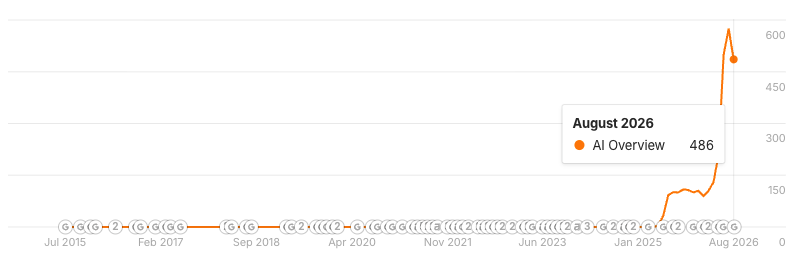
From zero to 486 mentions in AI answers within eight months. Second chart below.
From zero to 486 mentions in eight months
The first mentions appeared six weeks after we started – faster than classic search, because the models revisit their sources more often.
Want the same breakdown for your project?
Our Head of Inbound Sales will look at your site and niche and tell you what you can realistically expect. Including when the answer is “not much”.
Let's see what's holding your product back
We'll go through your site and niche and show you where the losses are. Free, and the document is yours.