Two agencies quote the same site. One says $1,500 a month, the other $6,000. Neither is lying. This is what sits behind the gap, and how to work out which number fits your case.
Written from B2B software and SaaS engagements, with the ranges we see quoted around us. No “it depends” without saying what it depends on.
Before comparing numbers, check you are comparing the same thing. There are four SEO pricing models, and they suit different situations.
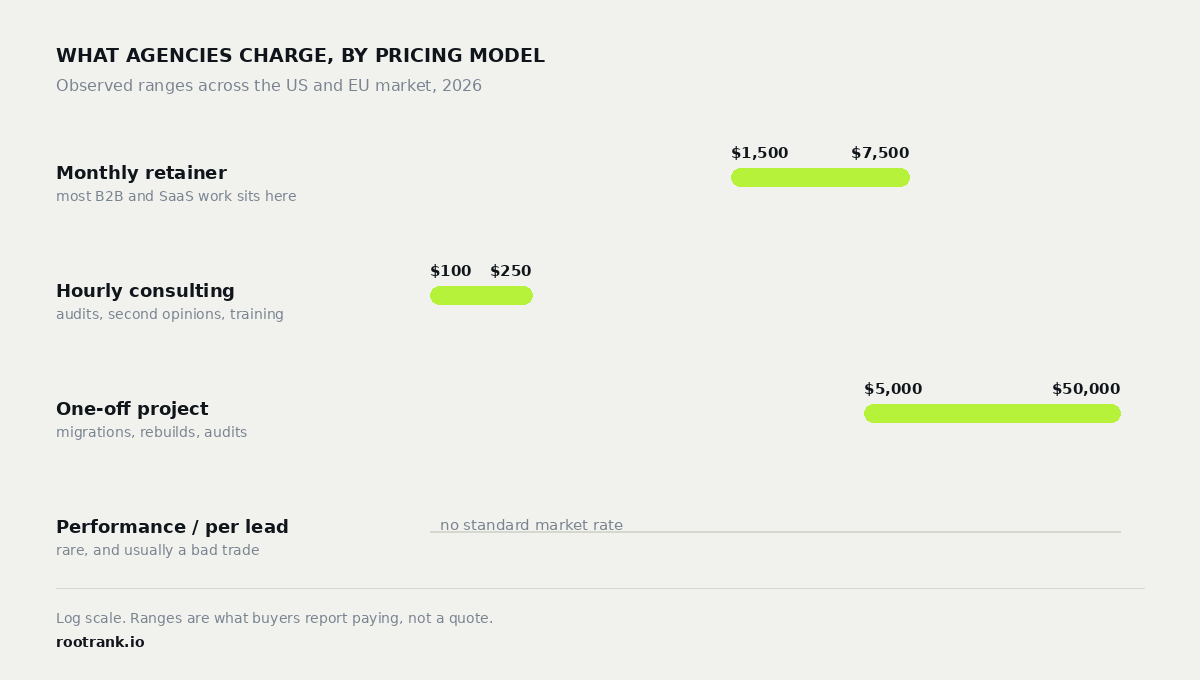
The monthly retainer is where almost all B2B and SaaS work sits. You buy a team for a period, not a list of tasks. It fits because search work compounds: month four depends on what shipped in month one, and nobody can scope that in advance without guessing.
Hourly makes sense for a bounded question. A second opinion on a migration plan, a training session for an in-house team, a review of someone else's audit. At $100 to $250 an hour it is expensive for ongoing work and cheap for a decision you are about to make wrong.
Project pricing suits work with a definable end: a technical audit, a migration, a site rebuild. The range is wide because a ten-page site and a hundred-thousand-page catalogue are the same word.
Performance pricing – pay per lead or per ranking – sounds fair and usually is not. The agency controls one input out of several: they do not control your pricing, your sales team, your product, or whether your competitor raised a round last month. In practice it pushes the agency toward whatever moves their metric fastest, which is rarely what grows the business. We do not offer it and would ask hard questions of anyone who does.
How much does SEO cost if you buy it as a monthly retainer? The honest answer has three bands, and SEO cost per month is the figure most buyers are actually comparing.
Under $1,000. At this level you are buying one junior person's part-time attention, or an offshore team running a checklist. It can work for a five-page local site. For a B2B product with a long sales cycle, the money is better spent on nothing at all: you get reports and no movement, and lose a year discovering it.
$1,500 to $4,000. Where most serious B2B and SaaS work happens. Enough to fund a small team – strategist, technical specialist, content, links – at meaningful hours. This is where we sit.
$5,000 and up. Large catalogues, several markets, multi-brand programmes, or competitive niches where the link gap runs into thousands of domains. Also where US agencies with expensive offices start, regardless of the work involved.
A number nobody publishes: the fee is usually the smaller half. Link placements, copywriting at volume and tooling can add as much again, and whether those sit inside or outside the retainer is the single biggest reason two quotes look different.
When we quote, five factors do almost all the work. They are the same five behind any honest quote.
Site size and technical state. A hundred-page marketing site and a fifty-thousand-page catalogue need different work at every stage. A site with broken rendering or a migration behind it needs months of repair before anything grows.
Competition in the niche. Not general difficulty – the specific gap between you and the three sites currently holding your queries. Closing a gap of two hundred referring domains is a different budget from closing two thousand.
How fast your developers ship. The most underrated factor. We can write the tickets in week two; if they reach production in month five, you have paid for three months of waiting. Teams with a weekly release cycle get results for meaningfully less money than teams shipping quarterly.
Content capacity on your side. If your specialists can review drafts within a week, content is cheaper and better. If nobody has time, we write more from scratch and check more externally, and both cost.
Number of markets and languages. Each additional market is not a translation, it is a separate demand map, separate structure and separate links. The second market usually costs less than the first because the process is already built.
Agencies rarely publish this, which makes the fee look arbitrary. Here is a typical split on a B2B software engagement, and it explains most of what sits behind SEO agency pricing.
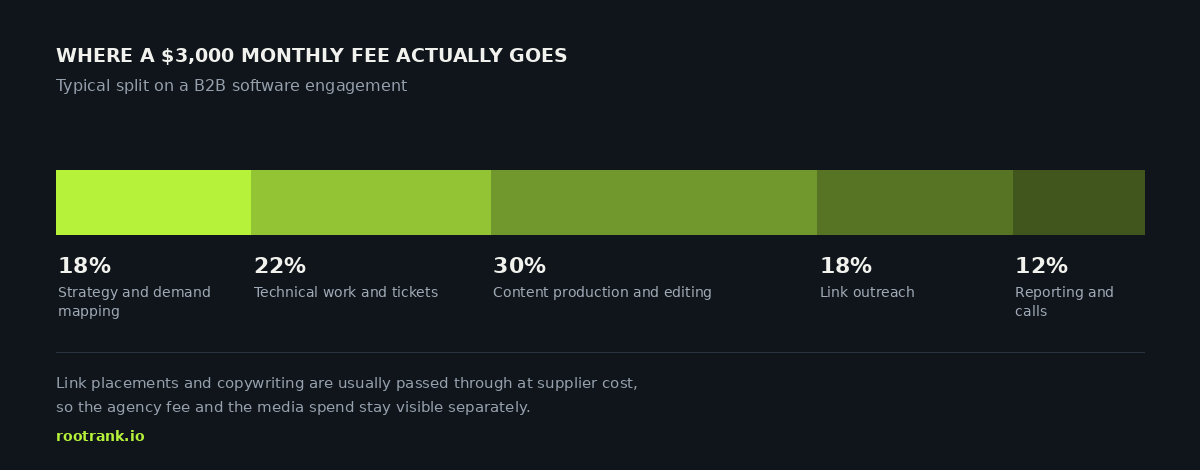
Two things are worth noticing. Content is the largest line almost everywhere, which is why agencies that quote low usually cut there first – fewer pages, or cheaper writers who cannot handle a technical subject. And reporting is a real cost: a fortnightly report that explains what moved takes hours, which is why cheap engagements send a dashboard link instead.
Ask any agency for this breakdown. The answer tells you more than the total does.
The failure mode is predictable enough to describe in advance. A $600 monthly engagement cannot fund a specialist reading your product documentation, so the content is written from competitor pages. It cannot fund real outreach, so links come from marketplaces. It cannot fund a developer's attention, so technical tickets are replaced by plugin settings.
Nine months later you have a site with fifty thin articles, a link profile that needs cleaning, and no answer to why the pipeline did not move. The cleanup costs more than the year of work did, and you have also lost the year.
This is not an argument for paying more. It is an argument for paying enough to fund the work you actually need, and for spending nothing if you cannot. A B2B product in a niche with two hundred monthly searches may not need an agency at all – and we say so on first calls more often than you would expect.
Pricing for SEO services is hard to compare because no two proposals describe the same scope. Four questions usually explain the whole gap.
What is inside the fee and what is billed on top? Link placements and copywriting are the usual candidates. A $1,500 quote with $1,500 of placements on top and a $3,000 all-in quote are the same price.
How many specialist hours a month, and at what seniority? “A dedicated team” can mean four people at four hours each, or one junior at forty. Ask for the number.
Who writes the content and who checks it? For a technical product this decides whether the content is usable. An agency that plans to write about your API without talking to an engineer is quoting for something you cannot publish.
What happens if you leave in month four? Who owns the keyword data, the briefs, the placed links. A cheap quote with a twelve-month lock-in is not cheap.
If the answers are similar and the prices still differ threefold, one of them is paying for an office in Manhattan.
We publish our prices, which is less common than it should be. Organic search and AI search together start at $1,500 a month, a technical audit is $500 one-off, and white label for agencies starts at $1,200 per project. The full breakdown, including what is billed separately at supplier cost, is on the pricing page.
The reason for publishing is practical rather than principled: it filters. Companies for whom $1,500 a month is impossible do not book a call, and neither of us spends an hour finding that out. Companies for whom it is trivial learn that we are not an enterprise agency, which is also useful.
Before any contract we calculate an expected payback month from your own numbers – traffic potential, conversion rate, deal value – and state the assumptions behind it. Sometimes that calculation says the niche will not repay the fee. That conversation is shorter than the alternative.

Alex will look at your site and niche and tell you which of the four demand buckets is empty. Free, and the document is yours.
The site address is enough. We'll build the demand map and show which clusters are covered and which are empty.
